
Find something new in the classics or how to find freedom in ballroom dancing: a little about American Smooth
American Smooth is a young trend; it is just beginning its journey in Russia, but is already extremely popular. What can we say about the USA, where this style originated and is still winning more and more fans every day. What attracts athletes and spectators to American Smooth, as well as how it differs from the already familiar European and Latin American programs, will be told to us by a dancer of the highest level, winner of more than 50 prestigious international festivals, competitions and championships, Evgenia Casanave.
.jpeg)
- Evgenia, you have extensive experience in dance sports and shows: you are the vice-champion of the World Cup in the “10 Dances” program, a prize-winner of the European Championship among “Professionals”, a participant in more than 200 major competitions in the world of ballroom dance. What attracted you to this direction? What was your first impression of American Smooth?
- The first time I saw American Smooth live was in America at the national championship. It started from the 1/8 finals, can you imagine! That's how many professionals dance American Smooth in the USA! Of course, my eyes widened. Everyone is so different, I want to look at all the couples separately, both this couple and the other; arms and legs are flying, everything is so beautiful and musical. I watched until the final, of course, and I got so much inspiration after this tournament - on the one hand, it looks like a show, and on the other, everyone is dancing my favorite European program, which I feel well. At the same time, there are many effective Latin elements: you can choose whatever you want, improvise; any movement you want to insert will not be wrong, but will only be an expression of your state, your emotions, your character, the style of your couple. To be honest, I wanted to try this direction for a long time, while still dancing in Russia, but at that time it was absolutely undeveloped. Then I moved to the USA, where I initially planned to compete in the European program, but after this tournament I was “hooked”, I realized that I wanted to dance and American Smooth too. Since then, I began to develop in American Smooth and at the same time continued my successful performances in competitive ballroom dancing.
- How does American Smooth differ from the European dance program?
- At first I thought that there was nothing complicated here - standard, latina, everything mixed together, and I could dance easily, because initially I dance “ten”, but that was not the case - the technique is very different. What I was used to dancing didn’t suit me - it was as if the world had turned upside down for me, right was now not right, left was not left. It’s difficult to explain in words, but the sensations in the body are radically different from the European program I’m used to. Here we dance the same steps in an open position, with completely different principles of leading and with different shapes - for me it was just a revolution in my head. I tried to infuse this information into myself as quickly as possible, assimilate it so that I could start dancing in tournaments, and after the basics were settled, I continued (and still continue) to develop in myself the freedom that smooth gives me.
- Tell us about the dances in American Smooth - how many are there, what are their features?
- There are only four dances in American Smooth - a slow waltz, tango, foxtrot and Viennese waltz - which I am very happy about, because four dances are much easier physically to dance than five. The main difference from classical ballroom dancing is in the music. It is more modern, has different rhythms within one melody. For example, tango is more like a kind of electro-tango. The second difference between the music is the tempo; it is a little slower than what is usual for ballroom dancers. This is done in order to have time to dance elements from both standard and Latin. Tango and waltz are very similar in character to the European program, and the foxtrot is more playful, there is no drawl or romance, there is more of some kind of flirting, flirting, there are elements of “old Hollywood”. American Smooth's foxtrot is more fun than the usual standard. The Viennese Waltz is the most spectacular dance in this direction, in my opinion. It is much more varied than in the European program; there are no monotonous movements. After all, what are we dancing in classical Viennese? Right, left, flecker, and that’s it... But here, on the contrary, there are a lot of movements, interpretations, everything looks very free, three-dimensional. Interestingly, it is the Viennese waltz that contains the most melodies from modern performers. For example, I really love dancing to Ed Sheeran and Christina Aguilera.
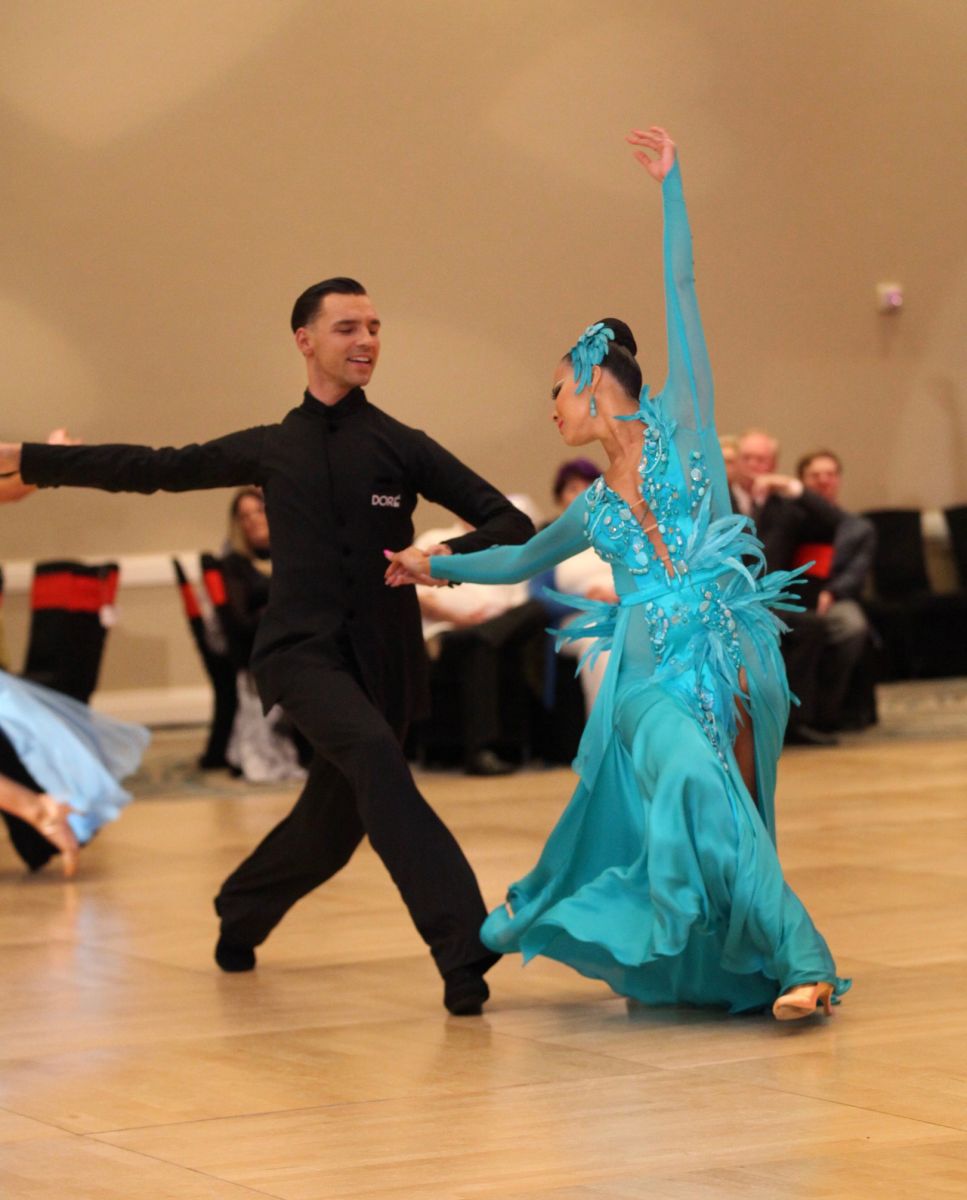
- What can you say about the costumes in American Smooth? Do they differ from the costumes of dance couples performing the European program?
- The costumes are very different. The partners' skirts are closer to the standard - most often long, although some look like a long latina with a slit, but in all cases the length of the main part of the skirt is ankle-length; but the upper part refers more to the Latin American program - often the dresses are asymmetrical, one side is open. There are no strict restrictions on costumes - you can choose any style of dress, if you wish, you can even dance in a mini, as long as it matches the style of your dance. The style of hairstyles and makeup is closer to Latin - brighter, bolder, there is no classicism and restraint inherent in the European dance program. Although again, there are no limits, some girls focus on elegance to highlight the couple's dance style. Many partners choose the “malvinka” hairstyle for performances: loose hair looks very impressive in the dance, adds volume and lightness to the couple, and since the upper part of the hair is removed, the strands do not interfere with the dancer.
- Based on your rich dance experience, you will certainly be able to answer the question, who has it easier in American Smooth: a standardist or a Latinist?
- This is if we do not take into account cases in which, like you, there is a strong base of 10 dances. I would say it’s not easy for both, because both need to adapt. Standard skaters have a good base of steps, as most of the movements in American Smooth are based on the European program, but the upper part work is closer to Latin, and therefore standard skaters who are used to keeping their hands in one position all the time may have problems at the beginning of the work. Latinists know what to do with their hands, but weight transfer, swing, and footwork have to be improved. So there are pros and cons for both standardists and those who previously specialized only in the Latin American program. Are there any skills that you had to develop when you started dancing American Smooth? Yes, sure. I realized that in smoothie I dance a lot of male steps, that is, the male part, which I had not danced before, but now I can. The second aspect is turns, but not Latin, but more with a reference to classical choreography: for example, in our variations we have a lot of rotations on one leg around its axis. Of course, neither standardists nor Latinists usually perform such turns, so I had to learn. Another point is that I dance independently, that is, I kind of dance the standard, but alone! All my partners will understand me now, this is not an easy task. In addition, it is very unusual to switch from familiar figures to show elements: you dance a right turn, and then you need to perform that same rotation on one leg! It took me time to teach both my body and my brain to readjust.
- In conclusion, how do you explain the popularity of American Smooth?
- I’ve been living in the USA for three years and I’ve been observing the development of this trend... And I’ll tell you that smoothie is still gaining popularity. Even then, a large number of couples danced it, but now there are many more professionals, there are more very good couples with each tournament, people switch from classical ballroom dancing to American Smooth, and very interesting duets are formed; for example, the partner danced only standard, and the partner danced only Latin. Thus, the couples' styles end up being completely different. Each couple is unique even for the viewer who sees dancing for the first time in his life, and this is captivating. Popularity is growing not only in America, but throughout the world, and this is largely due to the teachers who develop this type of dance. I don’t know how exactly to explain such popularity among dancers, but from my feelings I can say that in this type of dance there is more room for improvisation and self-expression, plus it is a combination of Latin and standard, complemented by lifts and other effective elements from different types of dance art - you dance everything at once. I can put my best into dance, but what else does a creative person need?